How to Start Selling Online: E-Commerce Inventory Management for UK Businesses 2026
Written by Calvin Lo, Founder of Aphelios Software | July 2026 | 7 min read
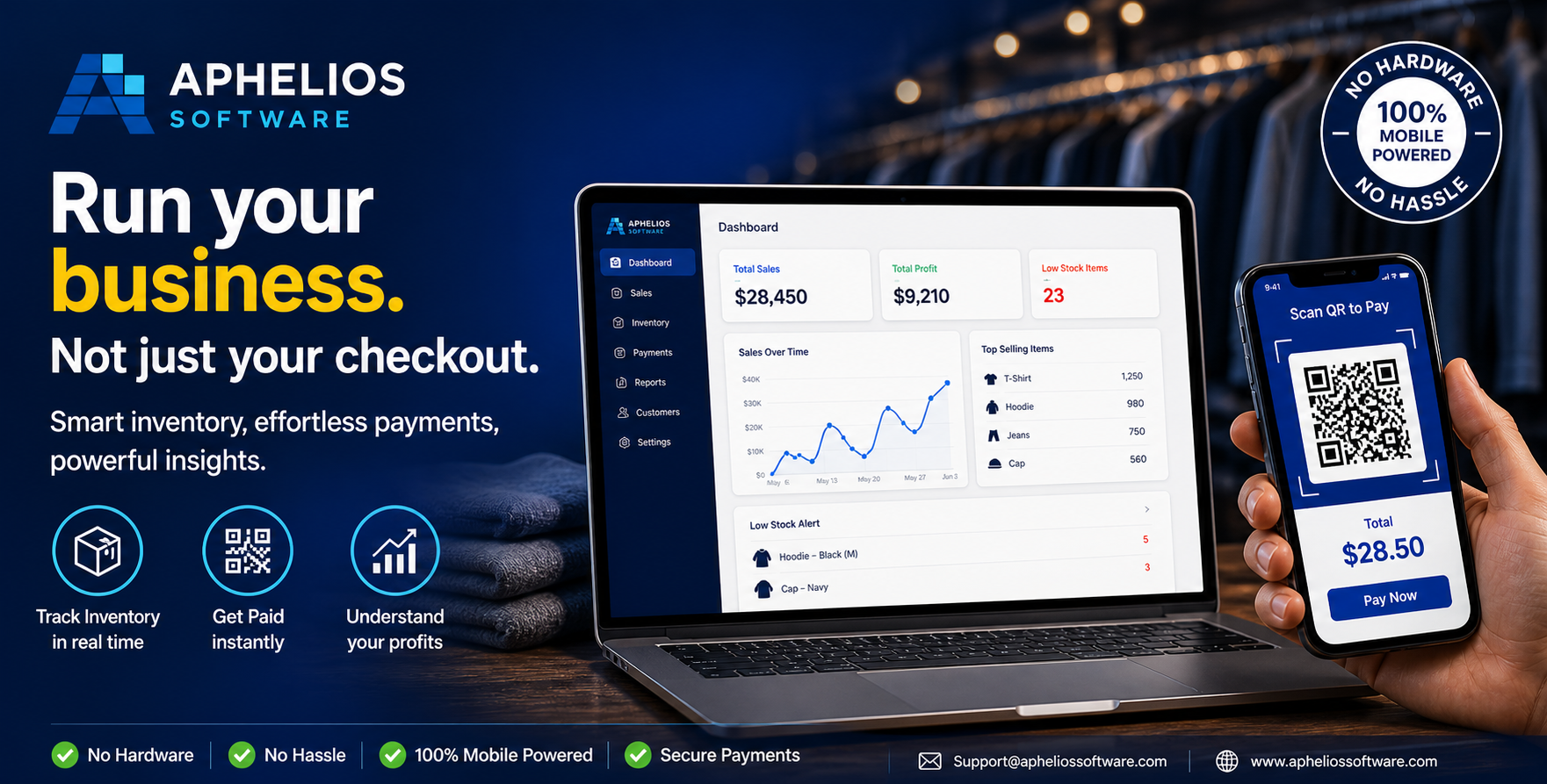
Selling online is one of the fastest ways to grow a UK business in 2026. Whether you are adding an e-commerce channel to an existing retail shop or starting a brand-new online venture, the businesses that succeed are the ones that manage their inventory properly from day one. Without reliable stock control, online selling quickly becomes chaotic: overselling, stockouts, delayed fulfilment and unhappy customers.
This guide walks you through everything you need to know about starting to sell online and managing your e-commerce inventory effectively. You will learn how to choose a selling platform, set up inventory management, connect payment processing, fulfil orders efficiently and scale your online business without losing control of your stock.
Why Inventory Management Matters for E-Commerce
When you sell online, your stock levels are visible to every customer in real time. Unlike a physical shop where a customer might notice a product is out of stock on the shelf, an online shopper sees what your system says is available. If your inventory data is wrong, you either lose sales by showing items as unavailable when you actually have them, or worse, you accept orders for products you do not have.
For UK e-commerce sellers, poor inventory management creates a chain of expensive problems. Overselling leads to cancelled orders and negative reviews. Stockouts send customers to competitors. Overstocking ties up cash in products that are not moving. Manual stock tracking across multiple platforms wastes hours every week and introduces errors that compound over time.
Effective e-commerce inventory management solves all of these issues. It gives you accurate, real-time visibility of every product across all your sales channels, automates reorder alerts when stock runs low and integrates directly with your online store so that every sale, return and stock adjustment is reflected instantly across your entire operation.
Step-by-Step Guide to Start Selling Online
Step 1: Choose Your Selling Platform
The first decision is where you will sell. UK sellers have several strong options, each with different strengths:
- Shopify: The most popular standalone e-commerce platform. Easy to set up, scalable, with a huge app ecosystem for payments, shipping and marketing.
- WooCommerce: A free WordPress plugin ideal for businesses that want full control over their website and content alongside their store.
- Amazon UK: Access to millions of buyers with built-in trust and logistics through Fulfilment by Amazon (FBA). Higher fees but massive reach.
- eBay UK: Strong for second-hand, clearance and niche products. Lower barrier to entry than Amazon.
- Etsy: The go-to platform for handmade, vintage and craft supplies. Built-in audience of buyers looking for unique products.
- Your own website: Using Shopify, WooCommerce or a similar builder gives you a branded store where you control the customer experience and keep more of your margin.
Many successful UK sellers use a combination of these platforms. Selling on your own website alongside Amazon or eBay maximises your reach while keeping your brand central. The key requirement when selling on multiple platforms is reliable inventory synchronisation, which we cover below.
Step 2: Set Up Your Inventory Management
Before you list your first product online, you need a system that tracks your stock accurately. Spreadsheets might seem sufficient at first, but they cannot synchronise across platforms, do not alert you when stock is low and become unmanageable once you have more than a handful of products.
Cloud-based inventory management software like Aphelios gives you a central stock database that connects to every sales channel. When a product sells online, stock levels update everywhere automatically. When you receive new stock from a supplier, you scan it in and your online store reflects the new availability within seconds.
Essential inventory features for e-commerce include real-time stock synchronisation, automated low-stock alerts, barcode and QR code scanning for fast stock adjustments, multi-channel support and the ability to track inventory across multiple locations if you operate a warehouse alongside your online store.
Step 3: Connect Your Payment Processing
Accepting payments online requires a reliable payment processor. Stripe is one of the most popular choices for UK e-commerce businesses, offering competitive fees of 1.5% plus 20p per UK card transaction with no monthly fees. Stripe supports Visa, Mastercard, American Express, Apple Pay and Google Pay through a single integration.
When your payment processor is connected to your inventory software, every transaction automatically updates your stock levels, records the sale against the correct product and customer, and feeds into your financial reports. This eliminates the need for manual reconciliation between your payment data and your inventory records.
Shopify and WooCommerce both have native Stripe integration. If you sell in person as well as online, a POS system with built-in Stripe integration ensures payments and inventory stay perfectly synchronised across every channel.
Step 4: Fulfil Orders Efficiently
Order fulfilment is the process of picking, packing and shipping products to your customers. A smooth fulfilment process depends on accurate inventory data and efficient workflows.
- Receive the order: Your platform receives the order and your inventory software immediately reserves the stock so it cannot be oversold on another channel.
- Pick and pack: Use barcode scanning to locate and verify the correct products, reducing picking errors to near zero.
- Generate shipping labels: Integrate with Royal Mail, DPD, Evri or other UK carriers to print labels directly from your dashboard.
- Ship and track: Mark the order as shipped, update tracking information and notify the customer automatically.
- Handle returns: Process returns through your system so returned stock is automatically added back to your inventory.
Businesses that automate this workflow using integrated inventory and order management software fulfil orders faster, make fewer mistakes and keep customers satisfied. Manual fulfilment processes break down quickly as order volume grows.
Comparison Table: E-Commerce Inventory Approaches
How do the different approaches to managing e-commerce inventory compare? Here is an honest look at the three main methods UK sellers use:
| Feature | Spreadsheets | Basic POS | All-in-One Software |
|---|---|---|---|
| Real-time stock sync | No: manual updates | In-store only | Yes: across all channels |
| Multi-channel support | No | Limited | Full integration |
| Barcode / QR scanning | No | Some models | Built-in |
| Low-stock alerts | Manual | Basic | Automated with reorder |
| Payment integration | None | Card reader only | Stripe + online + in-person |
| Order management | None | In-store only | Unified across channels |
| Risk of overselling | High | Medium | Very low |
| Monthly cost | Free | £20 - £80 | £25 - £99 |
For UK sellers serious about e-commerce, all-in-one software is the most cost-effective long-term solution. It eliminates the manual work and error risk that come with spreadsheets, and provides the multi-channel and payment integration that basic POS systems lack.
Multi-Channel vs Single-Channel Selling
Single-channel selling means operating on one platform only. This might be your own Shopify store, or just an Amazon UK listing. It is the simplest way to start, but it limits your reach and creates a single point of failure. If that one channel changes its fees, policies or algorithms, your entire business is affected.
Multi-channel selling means listing your products on two or more platforms simultaneously. This approach exposes your products to more buyers, reduces platform dependency and increases total revenue. However, multi-channel selling only works well when your inventory is managed centrally. Without synchronised stock, you risk overselling the same product across different platforms.
The ideal setup for most UK e-commerce businesses in 2026 is to sell on your own branded website plus one or two marketplace platforms, all connected through a single inventory management system. This gives you maximum reach with minimal operational complexity.
How Aphelios Connects E-Commerce with Real-Time Inventory
Aphelios Software is an all-in-one cloud platform built for UK businesses that sell online and in person. Here is how it brings your e-commerce operation together:
Stripe Payments Integration
Aphelios includes native Stripe integration so you can accept online card payments, Apple Pay and Google Pay directly through your platform. Every payment is automatically linked to the correct order, stock levels update in real time and your sales reporting reflects actual revenue without manual reconciliation. Stripe charges 1.5% plus 20p per UK card transaction with no monthly fees.
Automated Order Tracking
When a customer places an order online, Aphelios immediately records it, reserves the stock and moves it through your fulfilment workflow. You can see all orders from every channel in one dashboard, track their status from pending to shipped, and manage returns without touching a spreadsheet. This centralised order management saves hours of admin every week.
Real-Time Stock Synchronisation
Every sale, return, stock transfer and supplier delivery is reflected across all your sales channels instantly. If you sell the same product on your website and on Amazon, a sale on either platform updates the stock count everywhere. Low-stock alerts trigger automatically when inventory reaches your reorder threshold, so you never run out of best-selling products without warning.
POS for In-Person Sales
If you also sell at a physical location, market stall or pop-up event, the Aphelios POS system shares the same inventory database as your online store. Stock sold in person is deducted from the same pool that feeds your e-commerce channels, and vice versa. This unified approach prevents overselling and gives you a single view of your entire business.
Frequently Asked Questions
Can I sell on multiple e-commerce platforms at the same time?
Yes. Most UK sellers sell on multiple platforms simultaneously such as Amazon, eBay, Shopify and their own website. Using inventory management software with multi-channel support ensures stock levels are synchronised across every platform in real time, preventing overselling and keeping your operations efficient.
How do I avoid overselling when selling online?
Overselling happens when stock runs out on one channel but is still listed on others. Real-time inventory management software with automatic stock synchronisation prevents this by updating quantities across all channels the moment a sale occurs. Setting up low-stock alerts adds an extra safety net.
Is there a delay when syncing stock between online and in-store sales?
With modern cloud-based inventory software like Aphelios, stock synchronisation happens in real time. When a product sells online, your in-store POS stock level updates instantly, and vice versa. There is no manual step required and no waiting period for the synchronisation to complete.
What is the best way to manage inventory when starting to sell online?
The best approach is to use cloud-based inventory management software from day one. This gives you a single source of truth for all stock, integrates with your online platform and POS, and automates reorder alerts so you never run out of popular products. Starting with proper systems saves significant time and money as your business grows.
Related Articles
Multi-Channel Inventory Management
Sync inventory across Amazon, eBay, Shopify and your own store.
Read moreHow to Set Up Stripe Payments
Complete step-by-step guide to Stripe for UK small businesses.
Read moreOmnichannel Inventory Management
How to unify online and physical sales channels with real-time stock.
Read moreStart Selling Online with Confidence
Manage your e-commerce inventory, process Stripe payments and fulfil orders from one cloud platform. Aphelios gives you real-time stock control across every online and in-person sales channel. Start your free 14-day trial with no commitment required.
Start Free Trial