Best POS System for Takeaways & Fast Food UK 2026
Written by Calvin Lo, Founder of Aphelios Software | July 2026 | 8 min read
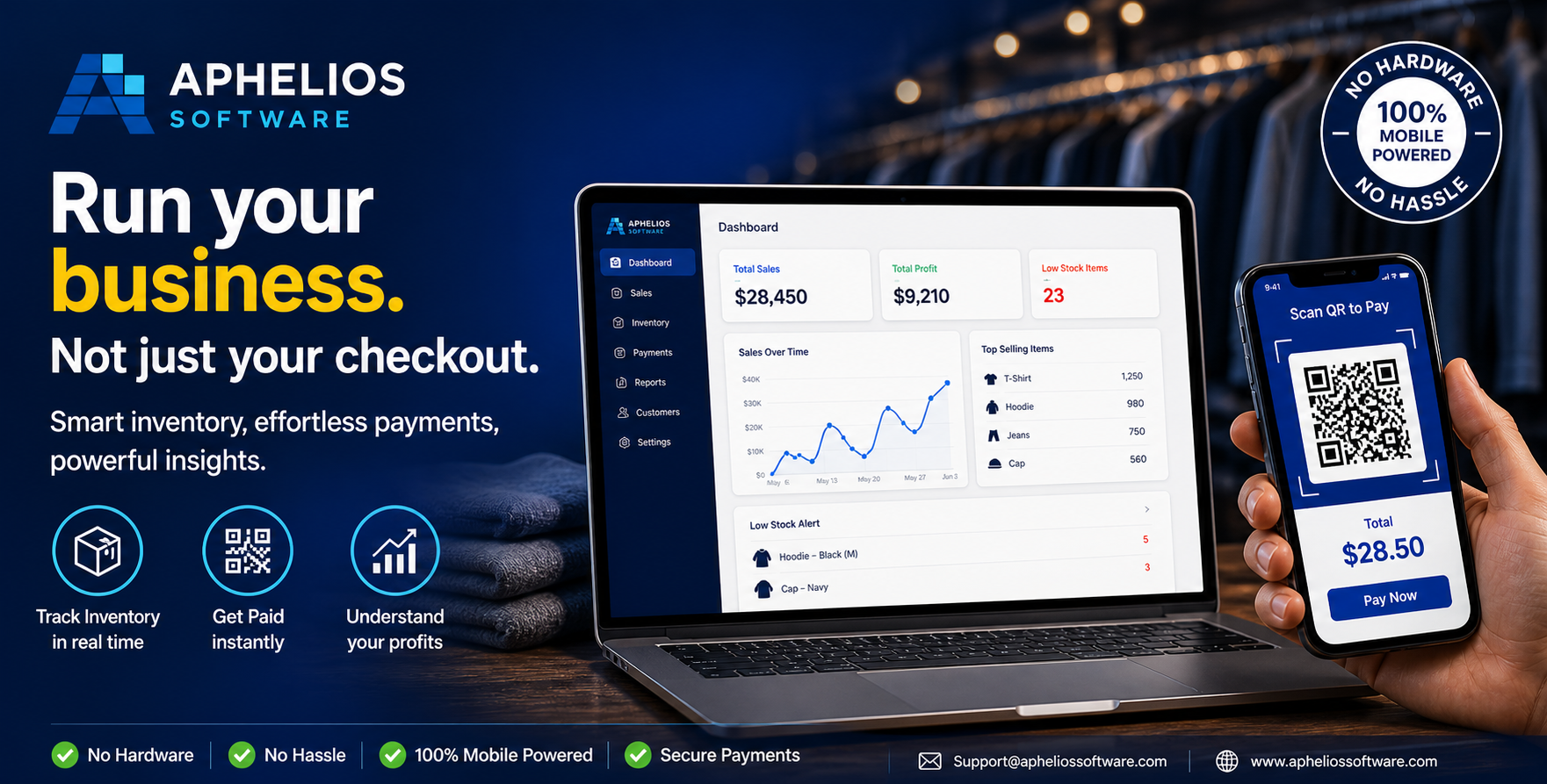
Running a takeaway or fast food business in the UK is relentless. Orders come in from the phone, the counter, Uber Eats, Deliveroo, and Just Eat - all at the same time. If your point-of-sale system cannot keep up with that pace, you lose revenue, frustrate customers, and waste staff time juggling separate tablets for each platform.
The right POS system for takeaway UK operations does more than process payments. It pulls every order channel into a single dashboard, syncs with your kitchen in real time, tracks ingredient usage automatically, and handles the speed that peak-hour fast food demands. In this guide we compare the leading options and explain what matters most when choosing a system for your takeaway in 2026.
What Takeaways Need From a POS System
Takeaways and fast food restaurants face a unique set of operational challenges that standard retail POS systems simply do not address. Speed is everything - a slow checkout during the Friday evening rush costs real money. But speed alone is not enough. Your system must also handle online ordering, delivery platform aggregation, kitchen workflow, and inventory tracking for perishable ingredients like meat, bread, sauces, and drinks.
- Online ordering integration - Accept orders directly from your own website without paying third-party commission fees on every transaction.
- Delivery platform sync - Receive Uber Eats, Deliveroo, and Just Eat orders into your POS automatically so staff only manage one screen.
- Kitchen display system (KDS) - Send orders straight to the kitchen with timing information, item modifiers, and priority flags.
- Quick checkout - Process contactless payments, card payments, and cash in under five seconds to keep queues moving.
- Tip management - Enable customers to add tips via card or QR code so staff are fairly rewarded for fast service.
Explore our POS System built for takeaways with integrated Stripe payments, QR ordering, and real-time inventory tracking.
Online Ordering Integration: Why It Matters
UK takeaway businesses lose thousands of pounds every year to delivery platform commissions. Uber Eats charges up to 35% per order, Deliveroo takes between 25% and 35%, and Just Eat typically charges 14% to 25% depending on your plan. If you are not offering your own online ordering channel, you are handing a significant slice of your revenue to third parties on every single order.
A POS system with built-in online ordering lets customers order directly from your website or a branded link. You keep a much higher percentage of the revenue, own the customer data for future marketing, and are not at the mercy of algorithm changes on delivery platforms. The best systems also support loyalty incentives and promotions that you control entirely.
Delivery Platform Sync: One Screen, All Orders
The most common headache for takeaway owners is managing multiple tablets - one for Uber Eats, one for Deliveroo, one for Just Eat, plus your own phone orders. During a busy evening, that means staff are constantly switching between screens, missing orders, and making errors when copying details manually.
Modern POS systems with delivery aggregation receive orders from every platform into a single dashboard. Staff see all orders in one queue, sorted by arrival time and priority. This reduces errors, speeds up preparation, and means you do not need three separate tablets taking up counter space. Some systems also update availability automatically on delivery platforms when items sell out, preventing customers from ordering dishes you have run out of.
Kitchen Display System for Fast Food
Paper ticket printers have been the standard in kitchens for decades, but they are slow, prone to getting lost, and impossible to reorganise once printed. A kitchen display system (KDS) replaces paper tickets with a digital screen that shows orders in real time.
- Orders appear on the kitchen screen the moment they are placed
- Colour-coded timing shows which orders are close to their target completion time
- Staff can mark items as complete with a single tap
- Modifications and special requests are displayed clearly next to each item
- Managers can see prep times and bottlenecks in real time from the POS dashboard
For fast food businesses where turnaround time directly affects customer satisfaction and delivery platform ratings, a KDS is no longer a luxury. It is a core operational tool.
Quick Checkout and Payment Speed
UK consumers overwhelmingly prefer contactless payments. According to UK Finance, contactless payments accounted for over 70% of all in-store card transactions in 2025. For takeaways, this means your POS must support tap-to-pay, Apple Pay, Google Pay, and chip-and-pin without any lag.
The difference between a 3-second checkout and a 7-second checkout might sound trivial, but across hundreds of transactions during a peak shift, it adds up to significantly more customers served per hour. Faster throughput also means shorter queues, which directly reduces the number of walkaway customers who leave because the line looks too long.
Tip Management for Takeaway Staff
Tipping culture in the UK has shifted significantly. More customers are happy to tip when prompted at the point of sale, especially for fast food and delivery orders where service speed is appreciated. A POS system with built-in tip management lets customers add a tip during checkout - either as a percentage, a round-up, or a custom amount.
This is particularly valuable for takeaways that rely on staff performance during busy periods. When tips are managed through the POS, they are recorded transparently, distributed fairly, and accounted for correctly in your accounts. It also removes the awkwardness of handling cash tips separately.
Comparison Table: Best POS Systems for Takeaways UK 2026
Below is a comparison of the leading POS options for UK takeaway and fast food businesses in 2026.
| Feature | Aphelios | Flipdish | Square | Lightspeed |
|---|---|---|---|---|
| Online Ordering | Built-in | Built-in | Basic | Add-on |
| Delivery Platform Sync | Yes | Yes | No | Limited |
| Kitchen Display | Yes | Yes | No | Yes |
| Inventory Tracking | Recipe-level | Basic | Limited | Good |
| Tip Management | Yes | Yes | Yes | Yes |
| Monthly Cost | From £29/mo | £69–£199/mo | Free–£60/mo | £69–£150/mo |
| Payment Processing | Stripe integrated | Stripe / own | 1.4% + 25p | Varies |
| Best For | All-in-one takeaway POS | Delivery-focused restaurants | Budget start-ups | Multi-site chains |
Flipdish: The Delivery-First Platform
Flipdish is built primarily for restaurants that rely heavily on delivery. It offers its own online ordering platform and integrates with major delivery services. The system is well designed for branded ordering websites and apps, which helps takeaway owners build a direct ordering channel separate from third-party platforms.
However, Flipdish pricing starts significantly higher than many alternatives, typically ranging from £69 to £199 per month depending on the features you need. For smaller takeaways with tight margins, that cost can be difficult to justify, especially when the inventory management and POS features are less developed compared to dedicated all-in-one systems. Flipdish is strongest for mid-to-large restaurants focused on growing their direct delivery channel.
Uber Eats Integration: Do You Need It?
Uber Eats remains one of the largest delivery platforms in the UK, and for many takeaways it is a significant source of orders. The question is not whether you should be on Uber Eats - most takeaways benefit from the exposure - but whether your POS can receive those orders without requiring a separate tablet.
A POS system with Uber Eats integration pulls orders into your main order queue automatically. This means kitchen staff see delivery orders alongside walk-in orders, reducing preparation delays and improving overall throughput. It also eliminates the risk of missing an order because nobody noticed the Uber Eats tablet buzz during a rush.
The key thing to check is whether the integration is a native part of the POS or requires a third-party connector. Native integrations are more reliable, update faster when Uber changes their API, and are supported directly by your POS provider.
Square: Budget-Friendly but Limited
Square is often the first system new takeaway owners consider because of its free plan and simple setup. And for very small operations - a solo fish and chip shop doing primarily walk-in orders - Square can be adequate. The hardware is affordable, the checkout is fast, and the basic sales reporting covers the essentials.
Where Square falls short for takeaways is in delivery platform integration, kitchen display, and advanced inventory. Square does not natively sync with Uber Eats, Deliveroo, or Just Eat, so you still need separate tablets for each platform. There is no built-in kitchen display system. And inventory tracking is limited to finished products rather than recipe-level ingredient deduction. For growing takeaways, these gaps become painful quickly.
Lightspeed: Powerful but Pricey
Lightspeed Restaurant is a comprehensive system with strong inventory, table management, and reporting features. It suits established restaurants with multiple locations and more complex operations. The reporting is detailed, the inventory system tracks ingredients, and the hardware options are professional-grade.
The main drawback is cost. Lightspeed starts at around £69 per month and can climb above £150 for the features most takeaways actually need. The onboarding process is also more involved than simpler systems, which means a longer setup time before you are fully operational. For single-location takeaways focused on speed and simplicity, Lightspeed can feel like more system than necessary.
How Aphleios Helps Takeaway Owners
Aphleios Software was built for small UK businesses that need more than a basic till but do not want the complexity and cost of enterprise systems. For takeaways and fast food operations, it brings several critical capabilities together under one roof.
All Orders in One Place
Whether an order comes in from the counter, your website, or a delivery platform, it appears in the same Aphleios order queue. Staff process every order from a single screen with no tablet juggling. This reduces errors, speeds up preparation, and keeps the kitchen running smoothly even during the busiest periods.
Recipe-Level Inventory
When a customer orders a chicken burger meal, Aphleios automatically deducts the chicken breast, bun, portion of chips, and sauce from your stock. You see real-time ingredient levels at any time, receive alerts when stock is running low, and can identify waste trends before they become costly problems. This level of inventory tracking is critical for takeaways managing perishable ingredients across high-volume order streams.
Stripe Payment Processing
Aphleios uses Stripe as its payment backbone, supporting contactless cards, Apple Pay, Google Pay, chip-and-pin, and all major UK payment methods. Transactions settle directly into your bank account with transparent, competitive fees. The real-time payment dashboard shows every transaction as it happens, so you always know your exact daily revenue.
Built-In Online Ordering
Instead of paying 25%–35% commission to delivery platforms on every order, Aphleios gives you a branded online ordering channel that customers can access from your website or a QR code. You keep more of each order, own the customer data, and are not subject to algorithm changes or commission increases.
Real-World Impact: Peak Hour Performance
Consider a typical Friday evening for a UK takeaway. Orders are coming in from the walk-in counter, the phone, Uber Eats, and your own website simultaneously. Without a unified POS, staff are switching between tablets, missing orders, and slowing down kitchen output. With a system like Aphleios, all orders flow into one queue, the kitchen display shows them in order of arrival, and staff process payments in seconds.
- Faster order processing means more customers served per hour
- Kitchen display reduces preparation errors and missed items
- Unified order queue prevents lost delivery orders
- Real-time inventory alerts prevent mid-rush stockouts
- Integrated payments mean accurate end-of-day totals without manual reconciliation
Common Mistakes When Choosing a Takeaway POS
- Choosing a retail-focused system that does not handle food modifiers or delivery sync
- Ignoring delivery platform integration and ending up with three separate tablets
- Prioritising low monthly cost over the features that actually save time during peak hours
- Not testing the system under real conditions before committing
- Overlooking recipe-level inventory, which prevents waste and ingredient shortages
- Forgetting to factor in per-transaction fees, which can add up significantly at high volume
How Much Does a Takeaway POS System Cost in the UK?
Costs vary widely depending on the provider and the features you need. Here is a general breakdown for 2026:
- Basic systems (Square, Zettle): Free to £30 per month - suitable for very small takeaways with simple needs
- Mid-tier systems (Aphelios): £29 to £60 per month - include online ordering, delivery sync, and inventory tracking
- Premium systems (Flipdish, Lightspeed): £69 to £199+ per month - full-featured but significantly more expensive
Always calculate the total cost including per-transaction fees, hardware costs, and any add-on modules. A system that looks cheap at £0 per month can end up costing more than a £29 per month system when you factor in higher transaction rates and the cost of separate delivery tablets.
Frequently Asked Questions
What is the best POS system for takeaways in the UK?
The best POS system for takeaways in the UK combines online ordering integration, delivery platform sync, kitchen display support, and fast checkout. Aphleios Software offers all of these features from £29 per month, making it a strong choice for takeaway owners who want everything in one place.
Do I need a separate system for Uber Eats and Deliveroo orders?
You do not need a separate system if your POS supports delivery platform integration. Modern POS systems like Aphleios can receive and manage orders from Uber Eats, Deliveroo, and Just Eat directly through the same dashboard, eliminating the need to juggle multiple tablets.
How much does a takeaway POS system cost in the UK?
Takeaway POS systems in the UK range from free basic plans (Square) to £60–£150+ per month for advanced systems with online ordering and delivery sync. Most providers also charge a per-transaction fee of 1.4%–2.5% on card payments.
Final Thoughts
Choosing the right POS system for your takeaway in 2026 is one of the most impactful operational decisions you will make this year. The difference between a basic till and a modern, integrated system shows up immediately in order speed, customer satisfaction, waste reduction, and revenue.
Takeaways that unify their order channels, automate inventory tracking, and integrate kitchen displays consistently outperform those that rely on manual processes and scattered tablets. Whether you choose Aphleios, Flipdish, Square, or Lightspeed, make sure the system you pick handles the specific demands of fast food and takeaway operations - not just generic retail.
For a deeper comparison of POS options across different business types, see our Best POS System for Small Business UK 2026 guide.
Related Articles
Best POS for Food Trucks UK 2026
Mobile-first POS solutions for street food and event traders.
Read moreBest POS for Cafes & Coffee Shops UK 2026
Compare top POS systems for UK cafes with inventory and table management.
Read moreBest POS for Small Business UK 2026
Our complete comparison of POS systems for all UK small business types.
Read moreStart Your Takeaway on the Right POS
Join UK takeaways already saving time and increasing revenue with an integrated POS system built for fast food.
Start Free Trial