AI-Powered Inventory Management: How UK Small Businesses Save 10+ Hours a Week
Written by Calvin Lo, Founder of Aphelios Software | July 2026 | 10 min read
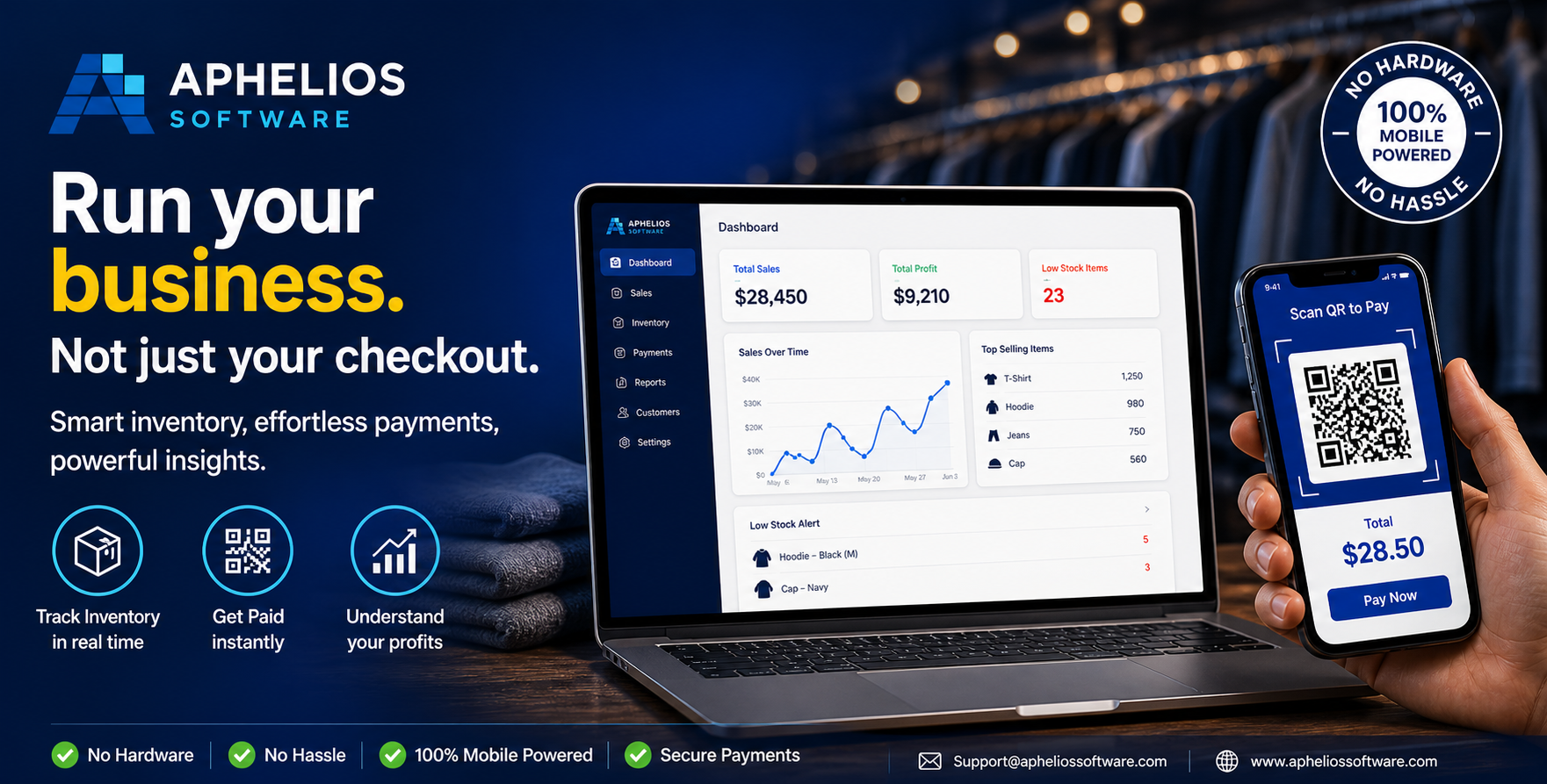
Inventory management is one of the most time-consuming tasks for UK small business owners. Whether you run a retail shop, a cafe, a takeaway, or an e-commerce operation, the daily routine of counting stock, placing reorders, checking deliveries, and trying to predict what customers will buy next eats into hours that could be spent growing your business.
According to the Office for National Statistics (ONS), UK labour productivity growth has been a persistent challenge, with output per hour worked remaining below pre-pandemic trends in many small business sectors. One of the biggest drivers of this productivity gap is manual operational tasks - and inventory management sits at the top of that list.
AI-powered inventory management software changes this equation entirely. Instead of manually tracking what you have, guessing what you will need, and reacting to stockouts after they happen, AI systems predict demand, automate reordering, and flag waste risks before they cost you money. In this guide, we explain exactly how AI transforms inventory management for UK small businesses and show you a step-by-step path to implementing it in your operations.
How AI Transforms Inventory Management
Traditional inventory management relies on human judgement. A shop owner checks the shelves, estimates what is running low, and places an order based on experience. This works tolerably during stable periods, but it breaks down during seasonal shifts, unexpected demand spikes, supplier delays, or when the business grows beyond what one person can mentally track.
AI-powered systems replace guesswork with data-driven predictions. They continuously analyse your historical sales data, identify patterns, and generate forecasts that adapt to changing conditions in real time. Here are the four core capabilities that make AI inventory management fundamentally different from manual approaches.
Demand Forecasting
Demand forecasting is the foundation of AI inventory management. Instead of ordering the same amount of stock every week regardless of actual demand, AI systems analyse your sales history across different time periods, days of the week, seasons, and external factors to predict how much of each item you will sell in the coming days and weeks.
For example, a small bakery that sells 40 sourdough loaves on a typical Monday but 65 on the first Monday of the month (because local office workers return from weekends) would see an AI system automatically adjust reorder quantities accordingly. A human ordering system would likely miss this pattern entirely, resulting in either waste from over-ordering or lost sales from under-ordering.
The accuracy of demand forecasting improves over time as the AI collects more data from your business. Most systems become noticeably more accurate within two to four weeks of consistent use, and the predictions continue to refine themselves as seasonal patterns, new product launches, and market shifts are incorporated.
Automated Reordering
Once an AI system understands your demand patterns, it can automate the reordering process entirely. Instead of manually checking stock levels every morning and placing orders with suppliers, the system calculates the optimal reorder point and quantity for each item based on current stock levels, lead times from suppliers, and predicted demand.
Automated reordering eliminates the most common inventory mistakes: ordering too much of slow-moving items, forgetting to reorder fast sellers, and placing emergency orders at premium prices because you ran out unexpectedly. It also frees up the significant amount of time that small business owners spend on supplier communications - estimated at three to five hours per week for a typical independent retailer.
The best AI inventory systems let you set custom rules alongside the automation. You can set minimum and maximum stock levels, define preferred suppliers for each product category, and approve or modify AI-generated purchase orders before they are sent. This gives you the efficiency of automation while maintaining full control over your purchasing decisions.
Pattern Recognition
One of AI's greatest strengths is identifying patterns that humans miss. A shop owner might notice that certain products sell better on weekends, but an AI system can identify far more nuanced patterns: that sales of a particular product spike three days after local payday, that a specific item consistently underperforms when displayed next to a newer product, or that weather patterns in your area correlate with demand for certain categories.
These pattern insights go beyond simple forecasting. They help you make better decisions about product placement, promotional timing, seasonal buying, and even whether to discontinue items that are quietly draining your cash flow. For small business owners who do not have the time or analytical tools to dig into their own data, AI pattern recognition surfaces these insights automatically.
Waste Reduction
Waste is one of the most significant and often invisible costs for small businesses, particularly those dealing with perishable goods. The Waste & Resources Action Programme (WRAP) estimates that UK food businesses waste approximately 1.3 million tonnes of food annually, with much of this attributable to over-ordering and poor demand prediction.
AI reduces waste by ordering closer to actual demand rather than ordering on a fixed schedule. It identifies items that are approaching their shelf life and suggests markdowns or promotions before they expire. It also highlights items with consistently low sell-through rates so you can reduce future orders or discontinue them entirely.
For a typical small food business, AI-driven waste reduction can cut spoilage costs by 20% to 40%, which often translates to hundreds or thousands of pounds saved per month. That saving goes directly to your bottom line without requiring any change in your product range or pricing.
Why UK Small Businesses Are Falling Behind on Productivity
The UK's productivity challenge is well documented. The ONS has reported that UK output per hour remains below the levels seen in comparable G7 economies, and small businesses are disproportionately affected. A significant contributor to this gap is the amount of time small business owners and their staff spend on manual operational tasks that could be automated.
Inventory management is one of the biggest time drains. A survey by the Federation of Small Businesses (FSB) found that the average small business owner spends approximately 12 hours per week on stock management tasks - checking levels, placing orders, reconciling deliveries, and investigating discrepancies. For businesses without dedicated inventory staff, this time comes directly out of the owner's capacity to focus on sales, marketing, and customer service.
AI-powered inventory management addresses this directly by automating the most time-consuming of these tasks. When the system can predict demand, generate purchase orders, track deliveries, and alert you to issues, the 12 hours per week shrinks to two or three hours of oversight rather than active management.
How Aphleios Uses AI for Inventory Management
Aphleios Software was designed from the ground up to give UK small businesses AI-powered inventory capabilities without the complexity or cost of enterprise systems. Here is how the platform addresses each of the core AI inventory functions.
AI Demand Forecasting
Aphleios analyses your historical sales data across all products and time periods to generate demand predictions. The system accounts for day-of-week variations, seasonal trends, and growth trajectories to forecast how much of each item you will need in the coming days. These forecasts update automatically as new sales data comes in, so the predictions stay accurate as your business evolves.
Automated Purchase Orders
When stock levels for any item approach their reorder threshold, Aphleios generates a purchase order based on the AI forecast and your supplier lead times. You review and approve the order with a single click, or set specific items to reorder automatically without approval. This eliminates the daily routine of manually checking stock and placing orders - saving hours every week.
Real-Time Stock Visibility
The Aphleios dashboard shows current stock levels across all products and locations in real time. You can see which items are running low, which are moving faster than expected, and which are sitting on shelves longer than they should. This visibility is available from your phone, tablet, or laptop, so you can check stock status from anywhere - not just from behind the counter.
Waste and Expiry Tracking
For businesses dealing with perishable inventory, Aphleios tracks product shelf life and alerts you when items are approaching their expiry dates. The system can suggest markdown pricing, recommend which items to promote first, and adjust future order quantities based on actual sell-through rates rather than fixed schedules.
Explore our Inventory Management Software to see how AI-powered tracking can transform your operations.
Step-by-Step Guide: Implementing AI Inventory Management
If you are ready to move from manual inventory management to an AI-powered system, here is a practical step-by-step guide for getting started.
Step 1: Audit Your Current Inventory Process
Before implementing any new system, document your current process. How often do you count stock? How do you place orders? Which items cause the most problems - stockouts, waste, or excess inventory? How many hours per week do you spend on inventory tasks? This baseline helps you measure the improvement after implementing AI.
Step 2: Choose a System That Matches Your Business
Not every AI inventory system is designed for every business type. A small retail shop has different needs from a restaurant, which has different needs from an e-commerce operation. Look for a system that integrates with your existing POS or sales platform, supports your product categories, and offers the specific AI features you need - forecasting, auto-reordering, or waste tracking.
Step 3: Input Your Product Data
Most AI inventory systems need your product list, current stock levels, and supplier information to get started. The more accurate this initial data is, the faster the AI can generate useful predictions. Some systems can import data from spreadsheets or existing POS systems, which saves significant setup time.
Step 4: Connect Your Sales Data
The AI needs your historical sales data to learn your demand patterns. Most systems need at least two to four weeks of sales history to generate meaningful forecasts, though you will see basic predictions from day one. If you are migrating from a POS system, connect it so the AI can access your full sales history.
Step 5: Configure Reorder Rules and Alerts
Set your minimum stock levels, preferred suppliers, lead times, and reorder preferences. Most AI systems let you customise these settings per product category. Start with conservative settings and adjust as the AI learns your patterns. Enable alerts for low stock, approaching expiry dates, and unusual demand spikes so you are informed without being overwhelmed.
Step 6: Monitor and Refine
For the first two to four weeks, review the AI's predictions and reorder suggestions regularly. Compare them against actual sales and adjust any settings where the system is consistently over or under-predicting. After this initial calibration period, the system should require minimal oversight - typically a quick daily review rather than active management.
The Time Savings Breakdown
Here is a realistic breakdown of where the 10+ hours per week in savings come from when you implement AI inventory management:
| Task | Manual Time | With AI | Time Saved |
|---|---|---|---|
| Daily stock checks | 5 hours/week | 30 min/week | 4.5 hours |
| Placing supplier orders | 3 hours/week | 15 min/week | 2.75 hours |
| Investigating stockouts | 2 hours/week | 10 min/week | 1.8 hours |
| Reconciling deliveries | 1.5 hours/week | 15 min/week | 1.25 hours |
| Waste investigation and reporting | 1 hour/week | 5 min/week | 0.9 hours |
That totals approximately 11.2 hours per week saved - over 580 hours per year. At an average owner hourly rate of £25, that represents over £14,500 worth of time recovered annually, not counting the additional savings from reduced waste and fewer lost sales due to stockouts.
Common Objections to AI Inventory Management
- "My business is too small for AI." - AI inventory tools like Aphleios are designed specifically for small businesses. You do not need thousands of products or a large team to benefit.
- "I do not trust algorithms to make ordering decisions." - AI generates recommendations; you still approve every purchase order. The system gives you better information to make faster, more confident decisions.
- "It will be too complicated to set up." - Most modern systems take less than an hour to set up. If you can import a spreadsheet and connect a POS, you have all the technical skills needed.
- "I already know my stock well enough." - Even experienced business owners miss patterns across hundreds of products over months of data. AI catches what human memory cannot.
Frequently Asked Questions
What is AI-powered inventory management software?
AI-powered inventory management software uses machine learning algorithms to analyse historical sales data, seasonal trends, and demand patterns to automatically forecast stock needs, trigger reorders, and reduce waste. It goes beyond basic stock counting by predicting what you will need before you run out.
How much time does AI inventory management save per week?
UK small businesses using AI-powered inventory systems typically save 10 to 15 hours per week by eliminating manual stock checks, automating purchase order generation, reducing time spent on supplier communications, and cutting down on emergency reordering caused by unexpected stockouts.
Is AI inventory management suitable for small businesses?
Yes. Modern AI inventory tools like Aphleios are designed specifically for small businesses. They do not require technical expertise to set up and work with your existing sales data to generate predictions from day one. The ROI is often visible within the first month of use.
How does AI reduce inventory waste for food businesses?
AI reduces waste by predicting demand more accurately than manual methods, identifying slow-moving items before they expire, optimising order quantities to match actual sales patterns, and flagging items that are approaching their use-by dates. For food businesses, this can reduce waste by 20% to 40%.
The Future of Inventory Management Is Predictive
The shift from reactive to predictive inventory management is one of the most significant operational improvements available to UK small businesses today. Businesses that continue to rely on manual stock checks, gut-feel ordering, and spreadsheet tracking will increasingly fall behind competitors who use AI to operate more efficiently.
The technology is no longer reserved for large enterprises with dedicated data teams. Modern AI inventory platforms like Aphleios make predictive inventory management accessible, affordable, and practical for businesses of every size - from a single-location cafe to a multi-site retail chain.
The 10+ hours per week you recover from manual inventory tasks can be redirected to sales growth, customer service, product development, or simply having more time to manage your business strategically rather than reactively. That is not a marginal improvement - it is a fundamental shift in how you spend your working week.
Read more about demand prediction in our Inventory Forecasting Guide for Small Businesses.
Related Articles
AI Business Intelligence for Inventory & Sales
How AI assistants transform data into instant business insights.
Read moreInventory Forecasting for Small Businesses UK 2026
Predict demand and optimise stock levels with data-driven methods.
Read moreInventory Management Software for Small Business UK
Compare the top inventory management platforms for UK SMEs.
Read moreReclaim 10+ Hours a Week With AI Inventory
Start forecasting demand, automating reorders, and reducing waste with inventory management built for UK small businesses.
Start Free Trial