AI Business Intelligence Assistant for Inventory & Sales
Written by Calvin Lo, Founder of Aphelios Software | June 2026 | 5 min read
Modern businesses are no longer limited to dashboards and static reports. With an AI Business Intelligence Assistant, you can now ask questions about your data and get instant answers in plain English.
Instead of manually filtering spreadsheets or building reports, decision makers can simply ask:
- What were my top-selling products this month?
- Why did refunds increase last week?
- Which items are low in stock?
- What is my revenue growth compared to last month?
What is an AI Business Intelligence Assistant?
An AI Business Intelligence Assistant is a conversational layer built on top of your business data. It connects to sales, inventory, refunds, and forecasting systems, then uses AI to translate that data into simple explanations.
Unlike traditional dashboards, it removes the need for technical skills such as SQL or data modelling. Instead, users interact using natural language.
Why Traditional Reporting Is No Longer Enough
Most businesses still rely on static dashboards, spreadsheets, or manually generated reports. These systems are slow, rigid, and often outdated by the time they are viewed.
- Reports require manual setup
- Insights are delayed
- Non-technical users struggle to explore data
- Important trends are often missed
AI changes this by making data interactive and conversational.
How the AI Business Intelligence System Works
The system is built around three intelligent layers:
- Live Business Data Layer – sales, inventory, refunds, trends
- Knowledge Base Layer – internal software instructions and help content
- AI Reasoning Layer – interprets and explains results
When a user asks a question, the system determines whether it relates to business metrics or system usage, then retrieves the correct context before generating a response.
Example of AI Business Intelligence in Action
This makes business intelligence accessible to everyone in the organisation, not just analysts.
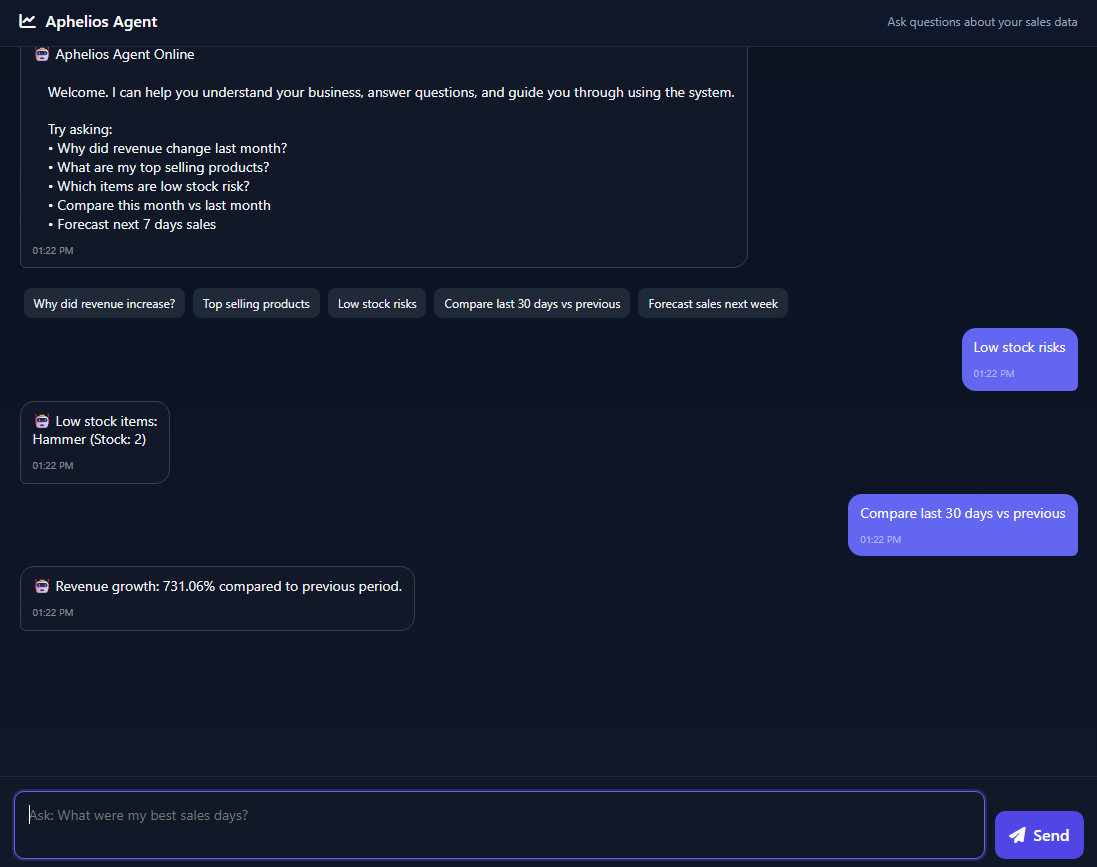
Instead of manually searching reports, users can ask:
"What are my top products this month?"
The AI instantly analyses sales data and returns a clear summary of top-performing products, revenue, and trends.
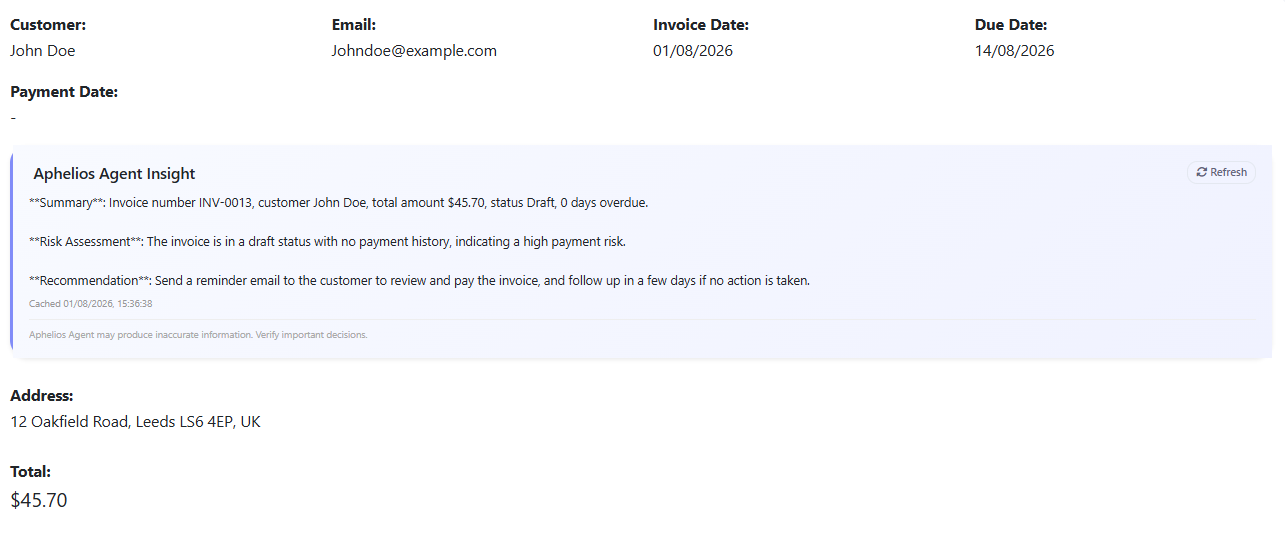
This makes business intelligence accessible to everyone in the organisation, not just analysts.
Key Features of the AI Business Intelligence Assistant
The assistant is designed to go beyond reporting by acting as a real-time analyst embedded directly inside your SaaS platform.
- Natural language business queries
- Real-time sales and inventory insights
- Refund and return analysis
- Product performance breakdowns
- Automated forecasting
- Low stock detection
- Knowledge base support for system usage
AI-Powered Inventory Intelligence
One of the most powerful applications is inventory intelligence. Instead of manually checking stock levels, the system proactively identifies risks and opportunities.
- Detects low stock items automatically
- Highlights fast-moving products
- Identifies slow-moving inventory
- Supports multi-location stock visibility
This helps businesses reduce overstocking, prevent stockouts, and improve cash flow.
Explore our Inventory Management Software to see how AI-powered tracking can transform your operations.
Sales Intelligence and Revenue Analysis
The AI assistant continuously analyses sales performance across time periods, products, and customer behaviour patterns.
- Monthly and daily revenue tracking
- Top-performing product identification
- Growth comparison over time
- Refund impact analysis
This allows businesses to quickly understand what is driving revenue and where improvements can be made.
Forecasting Future Sales
Using historical data trends, the system can estimate future performance using a simple moving average model.
For example, it can predict next week’s sales based on the previous 7 days, helping businesses plan inventory and staffing more effectively.
Knowledge Base Integration
Unlike generic AI tools, this assistant also understands your internal system documentation.
That means users can ask operational questions such as:
- How do I create a new user?
- How do I manage warehouse stock?
- How do I configure inventory settings?
The system prioritises knowledge base content over general AI responses, ensuring accuracy and consistency.
Security and Data Protection
Security is a core design principle of the AI Business Intelligence Assistant.
- Tenant-based data isolation
- No raw database exposure
- Aggregated metric processing only
- Prompt injection detection
- Response sanitisation layer
This ensures users only ever see relevant business insights without exposing sensitive system data or architecture.
AI vs Traditional Dashboards
| Feature | Traditional Dashboard | AI Assistant |
|---|---|---|
| Data exploration | Manual filters | Natural language queries |
| Speed of insights | Slow | Instant |
| User skill required | High | None |
| Flexibility | Limited | Highly flexible |
Example AI Conversations
Below are examples of how users interact with the system in real-world scenarios.
"What are my top 5 products this month?"
The AI returns ranked products with revenue contribution and performance insights.
"Why did refunds increase this month?"
The system analyses refund patterns and highlights potential causes such as product issues or seasonal demand changes.
"Which items are at risk of running out of stock?"
Low stock items are identified based on reorder thresholds and recent sales velocity.
Why This Matters for Modern Businesses
Business leaders no longer want static reports. They want answers.
This AI system transforms data from something you look at into something you talk to.
That shift dramatically improves decision-making speed, accuracy, and accessibility across teams.
Frequently Asked Questions
What is an AI Business Intelligence Assistant used for?
It is used to analyse business data such as sales, inventory, refunds, and trends using natural language queries instead of traditional reporting tools.
Do I need technical skills to use it?
No. Users can simply ask questions in plain English and receive instant answers without needing SQL or analytics experience.
How is this different from a dashboard?
Dashboards show static data. The AI assistant allows interactive conversations with your data, making insights faster and more flexible.
Is the data secure?
Yes. The system uses tenant isolation, data aggregation, and strict prompt safety rules to ensure no sensitive information is exposed.
Can it forecast future sales?
Yes. It uses historical trends and moving averages to estimate future performance and help with planning.
Does it work with inventory systems?
Yes. It is designed specifically to work with inventory, sales, and warehouse management systems.
The Future of Business Intelligence
The future of analytics is conversational. Instead of navigating complex dashboards, businesses will simply ask questions and receive answers instantly.
This shift reduces dependency on analysts, speeds up decision-making, and democratizes access to data across entire organisations.
Why Aphelios AI BI Assistant Stands Out
- Built directly into your SaaS platform
- Combines live business data + knowledge base + AI reasoning
- Secure multi-tenant architecture
- Designed for inventory and sales intelligence
- Fast, scalable, and production-ready
Internal Resources
Explore more about how Aphelios helps businesses manage and optimise operations:
- QR Code Inventory System Guide
- What is Inventory Management Software?
- AI Inventory Forecasting Explained
- Inventory Software Guide
Final Thoughts
An AI Business Intelligence Assistant is not just a feature upgrade. It is a fundamental shift in how businesses interact with data.
Instead of waiting for reports, teams can now ask questions and get instant clarity on performance, risks, and opportunities.
This makes decision-making faster, smarter, and more accessible across every level of the organisation.
Related Articles
Turn Your Business Data Into Instant Answers1
Stop building reports. Start asking questions. Aphelios AI helps you understand your sales, inventory, and performance in seconds.
Start Free Trial